
The GUI moment
We’re in the DOS era of AI, relying on raw, text-heavy natural language. The next GUI moment is coming, and it won’t just change how we interact with tech, but how we interact with the world.


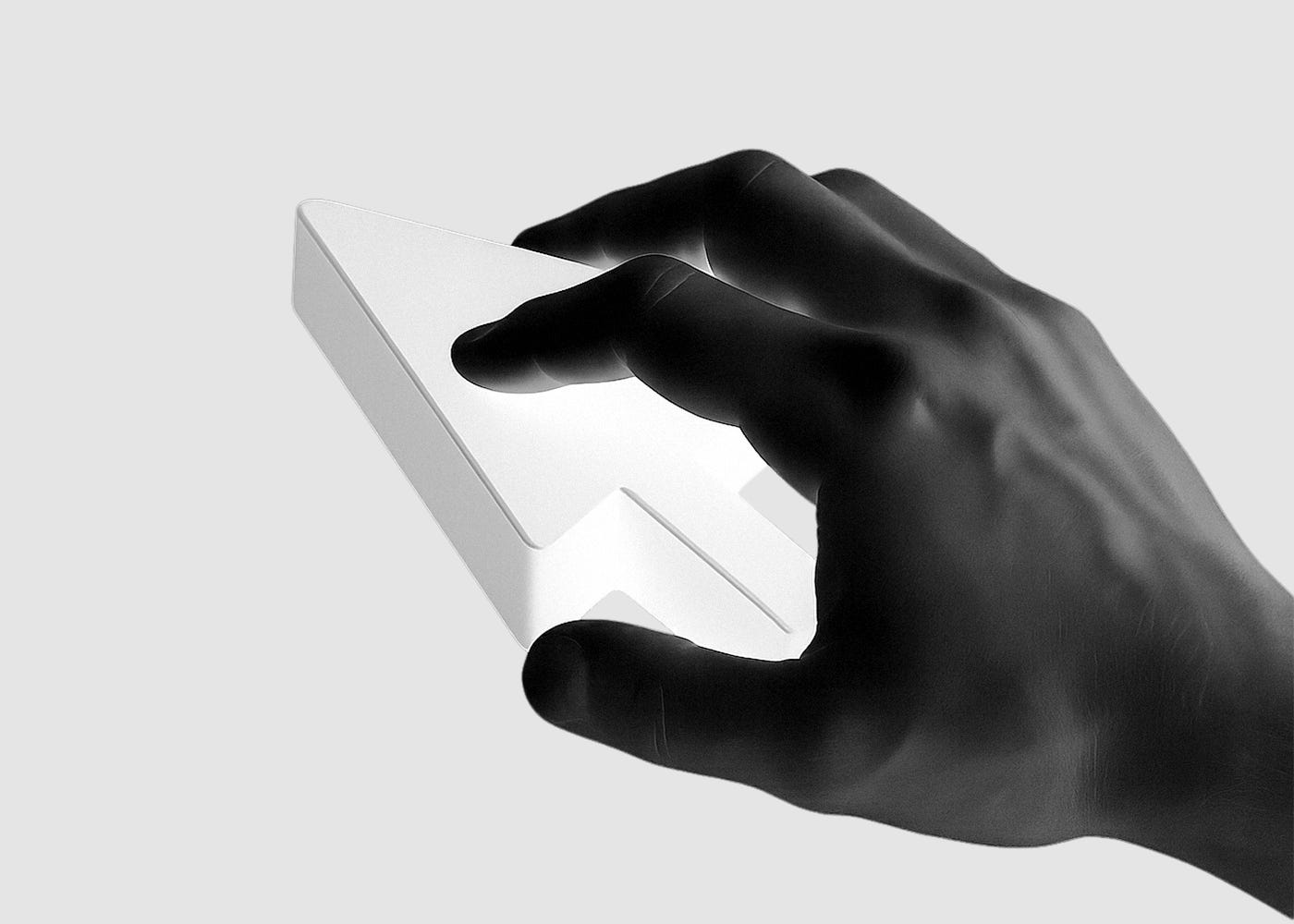
Today’s interfaces still speak a language closer to code than conversation. They’re built for commands over connection, prompts over presence, iteration over progression. We’re typing in the dark; into machines that already understand more than we know how to ask.
And yet, it’s working. Which is exactly the problem.
The limits of language
Text is powerful, but its role in natural language and interaction is limited. It compresses multidimensional intent into a linear form, favoring those who can articulate their thoughts over those who can imagine them.
This constraint is evident in the current state of prompt-based AI interaction: somewhat effective, but far from expressive.
Music production provides a fitting analogy. While technology offers sophisticated tools, from expressive keyboards to advanced MIDI utilities, the gap between drawing or generating MIDI and playing live remains stark. Technically correct, yet often emotionally inert.
We’ve handed people near-infinite intelligence through command-line-like interfaces. Capable, but cognitively heavy. Systems that understand more than we know how to express.
It’s something we’re still learning how to communicate with, much like in Arrival, where Louise gradually learns to speak with the Heptapods by first reshaping her perception of language.
The nature of interaction shapes the medium

Every breakthrough in computing came with a shift in how we interact.
The GUI wasn’t just decoration over code; it was a new way of thinking and operating through machines. By adding a visual layer, it didn’t just make computing more accessible; it opened the door to entirely new kinds of creators.
As interaction evolved, new paradigms emerged, from mouse to multitouch, from click to voice.
However, voice-driven commands were, at their core, a verbal form of text input, still anchored to visual frames and explicit physical triggers. Advancements in conversational interfaces have revealed the potential of contextual dialogue, bringing us closer to a more dimensional form of interaction.
In this context, CLI, GUI, and VUI are not separate paths; they’re branches of a deeper evolution. Yet we’re still waiting for the interface to catch up with the intelligence.
So, what type of interface are we anticipating, and what kind of interaction are we aiming to shape?
Toward ambient interaction
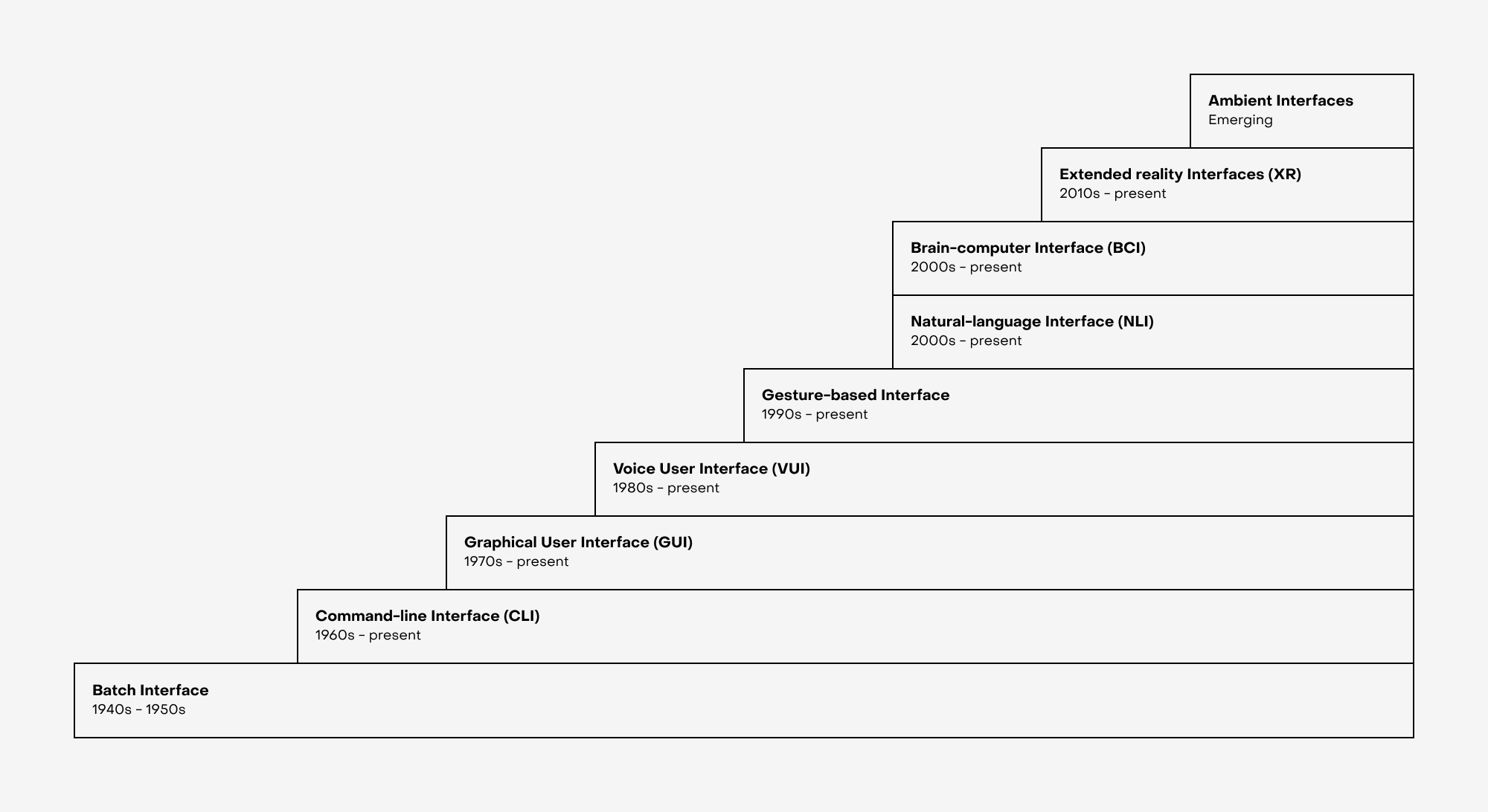
An interface that disappears into context, attuned to time, space, ambience, and intent. This long-held dream of computing is finally within reach, as Artificial Design Intelligence emerges not merely as a tool, but as its enabler.
This shift calls for a new design paradigm:
Design memory
Systems that learn and evolve, embedding legacy knowledge, accumulating experience, and refining interaction over time.Multimodal fluency
Interaction that moves seamlessly across voice, vision, gesture, text, motion, and space, as a unified language.Spatial logic
A shift beyond flat screens toward layered, contextual, embodied environments, physical, digital, and hybrid.Semantic surfaces
Interfaces that listen, understand, adapt, and participate.The tangible and the speculative
Designing for what is, while prototyping what might be, grounding the future in reality without limiting its scope.
An extended, humane experience, as architecture for a world with no clear edges. Fluid. Contextual. Omnipresent.
A language that explores new paths, moves in rhythm, and shapes the grammar of intent.
About
smmn is a journal of interaction, memory, and the shape of the future.
We’re just tuning in.
→ Follow smmn for more essays.
→ Visit the site for the news, tools, and future drops.
This idea of Ambient Interfaces reminds me of Isaac Asimov's short story "The Final Question". In the story, humanity invents a computer system that eventually evolves to be omnipresent and omniscient. Interacting with the system takes little effort as the system's understanding of the world and user's context is complete. This starkly contrasts today's ChatGPTs that tend to frustrate the user more than they help regardless of effort in providing as much context as you can.